


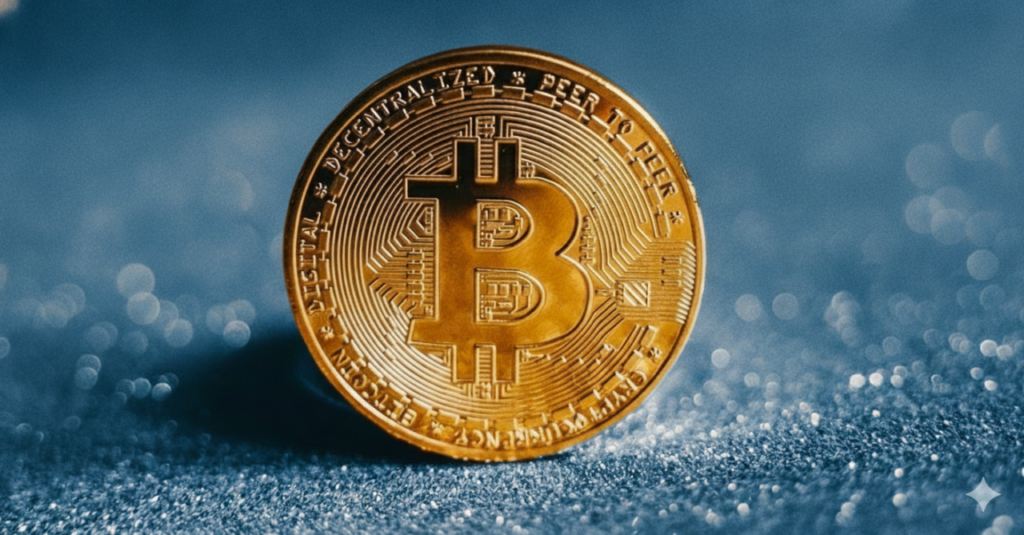
What is Bitcoin – how it works and why it matters
Bitcoin is digital cash you can send directly to someone else online without needing a bank. It operates on a global network of computers that ensures everything remains secure and honest. It matters because it’s a new kind of money that no single company or country owns, and many people view it as a means to preserve value for the future, akin to digital gold.
Introduction
Think about the money in your bank app. It’s digital, right? But it’s still controlled by your bank. Now, imagine money that lives entirely on the internet, with no boss. A mysterious person (or group) known as Satoshi Nakamoto created Bitcoin in 2009. The idea is to create a money system for the people, run by the people.
What is Bitcoin?
In the simplest terms, Bitcoin is a new form of money that is completely digital and decentralised.
Before Bitcoin, creating a digital currency that couldn’t be copied was a significant challenge. If you email a friend an MP3 file, you still have the original. But with money, you can’t have that. You can’t “corequire a middleman, such as a bank, to verify first to solve this “double-spending” problem without needing a middleman like a bank to check everything.
How is it different from normal money?
1. No Central Control:
A government issues your normal money (Dollars, Euros). Bitcoin isn’t. It’s run by a network of computers all over the world.
2. Limited Supply:
Banks can print more money whenever they want. With Bitcoin, the rules are set in code: there will only ever be 21 million bitcoins. This makes it rare, like gold.
3. See-Through:
All Bitcoin transactions are recorded on a public list that anyone can check. It’s transparent.
4. Open to Everyone:
You don’t need permission to use it. All you need is an internet connection.
Also Read: Bitcoin History
How Bitcoin Works
You don’t need to be a tech genius to get the basic idea. Here’s how it all comes together.
Blockchain & Ledger
Imagine a shared Google Sheet that everyone in the world has a copy of. This sheet records every single Bitcoin transaction ever made. This is the “blockchain.”
When you send Bitcoin, your transaction is grouped with others into a “block.” This block is then added to the “chain” of all previous blocks. Once it’s on there, it’s pretty much impossible to erase or change. Because everyone has a copy, it’s very hard to cheat.
BTC Transaction Example: A Simple Analogy
Let’s say Sarah wants to send 0.05 BTC to her friend Tom.
- Sarah uses her Bitcoin wallet app to send the Bitcoin to Tom’s wallet address (like an email address for Bitcoin).
- This transaction is broadcast to the whole network of computers.
- “Miners” on the network hear this and race to check if Sarah actually has the 0.05 BTC to send.
- They do this by solving a highly complex mathematical puzzle. It requires a significant amount of computer power.
- The first miner to solve the puzzle shouts, “I’ve got it!” The other miners quickly check their work.
- Once most agree it’s correct, the new block of transactions (including Sarah’s) is added to the blockchain.
- The transaction is “confirmed,” and Tom sees the Bitcoin in his wallet. Done!
Brief about Proof of Work (PoW)
Proof of Work is that “math puzzle” the miners are solving. It’s designed to be hard. This difficulty is what keeps the network secure. Trying to fake a transaction would require you to solve these puzzles faster than everyone else combined, which is pretty much impossible. It’s like a security system that runs on brainpower.
Brief about Bitcoin Mining
Bitcoin mining is the job of those computers. They keep the network running and secure by verifying transactions and solving complex mathematical puzzles. It’s called “mining” because, as a reward for their work, the winning miner receives some brand-new Bitcoin. This is how new Bitcoin enters the system.
Use Cases & Real-World Applications of Bitcoin
So, what do people actually do with Bitcoin?
Sending Money Abroad:
Sending money across borders with a bank can be slow and expensive. Bitcoin can often be faster and cheaper.
A Savings Account (Digital Gold):
Because there’s a limited supply, many people buy and hold Bitcoin, hoping it will be worth more in the future, just like people invest in gold. This is its biggest use case right now.
Buying Things:
A growing number of companies, from big ones like Microsoft to small online shops, accept Bitcoin as payment.
New, Cool Uses:
New tech, like the “Lightning Network,” lets you buy a coffee with Bitcoin instantly. It’s also being used in new, internet-only financial systems (often called DeFi).
Origin & Vision of Bitcoin
The history of Bitcoin is like a tech mystery novel. In 2008, someone named Satoshi Nakamoto published a document (a “whitepaper”) explaining the idea. In 2009, they released the software. Then, they vanished.
Their vision was simple but powerful: create a money system that is peer-to-peer. This means you can send money directly to your friend without a bank intermediary. The goal was money that was free from control, unencumbered by censorship, and accessible to everyone on the planet.
How Many Bitcoins are There?
As of now, over 19.5 million bitcoins have been mined. The rules of the system say that there will never be more than 21 million. The creation of new Bitcoin slows down every four years, an event known as “the halving.” The last Bitcoin is expected to be mined around the year 2140.
Challenges & Risks
Bitcoin isn’t perfect. Here’s what you should watch out for:
- The Price Goes Up and Down…A Lot: The value of Bitcoin is super volatile. Its price can skyrocket, but it can also crash. Don’t invest money you can’t afford to lose.
- Government Rules: Governments are still grappling with how to regulate Bitcoin. New laws could affect its use and value.
- Security is Your Job: The Bitcoin network is highly secure; however, if you lose the password to your wallet, your Bitcoin is lost forever. Also, some websites that hold Bitcoin for you (exchanges) can be hacked.
- It Can Get Slow: Sometimes, when the network is busy, transactions can get slow and expensive.
Future Outlook & What to Watch
Where is Bitcoin headed?
- Better Tech: People are continually working on upgrades to make Bitcoin faster and more affordable for small, everyday purchases.
- Going Mainstream:Big investment firms and companies are now getting involved, which makes Bitcoin more normal and accepted.
- A Small Piece of a Portfolio: Some financial experts now say it might be okay to put a very small amount of your savings into Bitcoin, as long as you understand the risk.
For those curious about its potential value, check out our Bitcoin Price Prediction 2026 -2030 for insights on what the future might hold.
Final Thoughts
So, what is Bitcoin? It’s the world’s first successful form of digital cash that doesn’t need a boss. It functions like a shared public record book, secured by a global network of computers. It matters because it gives us a new way to think about and use money. While it’s risky and the price is all over the place, its potential as a global, open savings technology is why so many people are talking about it. Understanding what actually a bitcoin is the first step into a whole new world of digital money.