


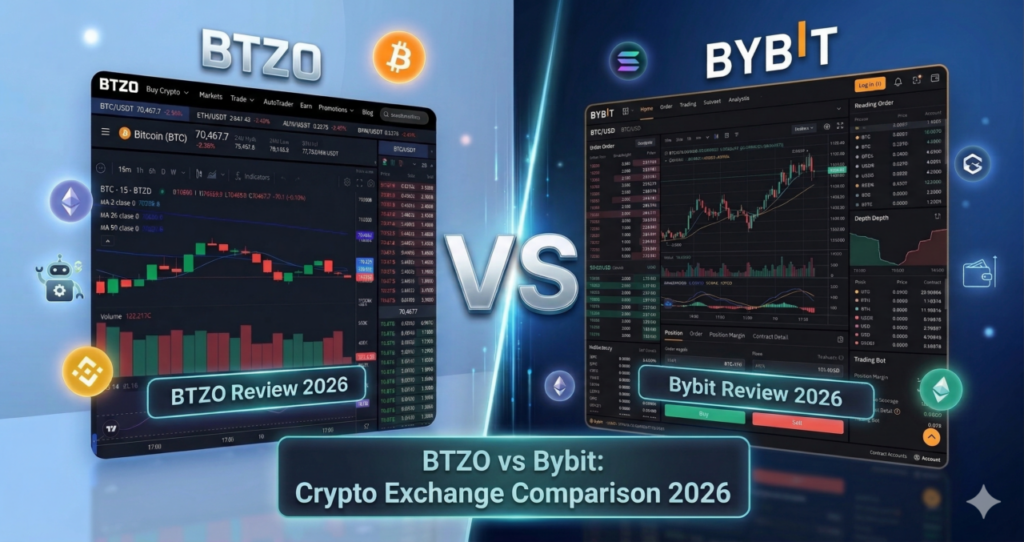
Picking the wrong crypto exchange is expensive. Unexpected fees, clunky apps, and missing features can chip away at your profits before a single trade even closes. That’s why the BTZO vs Bybit debate matters – especially for traders who want every advantage they can get in 2026.
Both platforms target active crypto traders, but they take very different roads to get there. BTZO is a fast-growing exchange built with simplicity and low costs at its core – a great fit for traders at any level. Bybit is a global heavyweight with deep liquidity and a wide product range, but that breadth comes with complexity and higher fees.
In this comparison, we’ll break down both platforms across:
- User experience & mobile app
- Fees & costs
- Security & compliance
- Trading tools, automation & bots
- Supported assets & markets
Let’s get into it.
BTZO and Bybit at a Glance
BTZO at a Glance
Yes, BTZO crypto exchange is an emerging crypto exchange designed for traders who want pro-level tools without the pro-level headache. The key highlights include ultra-low fees from 0.05%, a clean and intuitive btzo trading app, automation tools, spot and futures markets, and an Earn suite where idle crypto can earn passive income. Designed to be beginner-friendly and powerful enough for pros.
Bybit at a Glance
Bybit is one of the world’s top exchanges by trading volume, known for deep liquidity, a wide selection of derivatives, and a comprehensive ecosystem including copy trading, NFTs, and Web3 features. It’s a powerful platform – but it’s built for experienced traders. Beginners often find it overwhelming, and fees can creep up depending on product and tier.
Feature-by-Feature Comparison: BTZO vs Bybit
Trading Products & Markets
| Feature | BTZO | Bybit |
|---|---|---|
| Spot Trading | Available | Available |
| Futures Trading | Available | Available |
| Leverage | Up to 100x | Up to 100x |
| Copy Trading | Available | Available |
| Automation / Bots | Built-in AutoTrader | Grid Bots |
| Earn Products | Staking + Fixed/Flexible Savings | Bybit Earn (Select products) |
| NFT / Web3 | Focused on trading | Full NFT Marketplace |
| Supported Assets | Major + growing list | 900+ cryptocurrencies |
| Best For | All levels, esp. active traders | Experienced traders |
Here’s how the two platforms stack up on what you can actually trade:
Fees & Pricing
Fees are where the actual difference lies. BTZO trading fees begin at a mere 0.1% for spot (maker) and 0.02% for futures (maker) – which is hard to beat. Bybit spot trading fees begin at 0.10% and futures at 0.01% maker fee / 0.06% taker fee, with fee discounts based on VIP level or holding their BIT token.
Withdrawal fees are where both exchanges stand on par. BTZO is upfront about their withdrawal fees. Bybit’s withdrawal fees are more asset-dependent and may surprise you.
Both exchanges offer referral bonuses, but BTZO’s referral program is designed to reward smaller, more engaged communities, not just institutional referrals.
User Experience & Interface
This is where BTZO genuinely shines for everyday traders. The web interface is clean, fast, and uncluttered – you won’t spend 10 minutes hunting for the order button. The dashboard is customisable, and charts are powered by TradingView with 100+ indicators built in. Real-time price alerts, one-tap order placement, and portfolio tracking make it one of the best app for crypto trading available today.
Bybit’s interface is powerful, but the sheer volume of features – derivatives, Web3, NFTs, Launchpad – can be overwhelming for new users. The mobile app is highly rated but best suited to traders who already know their way around complex platforms.
Security & Compliance
Security isn’t optional – it’s the foundation. According to cryptocurrency security standards, best practice requires cold storage, 2FA, and regular audits. Both BTZO and Bybit tick these boxes.
BTZO: Cold storage for 95% of assets, two-factor authentication, withdrawal address allowlisting, IP-level access management, and regulatory compliance in line with international laws.
Bybit: Multi-sig cold wallets, 2FA, and a good reputation. However, Bybit has had a high-profile security problem in 2025 – a reminder that no matter how big the exchange, there is always a risk.
Unique Selling Points (USPs)
What makes BTZO stand out:
✓ Low, transparent fees from day one – no VIP tier required
✓ Built-in BTZO AutoTrader for automation without coding
✓ Up to 100x leverage for experienced derivatives traders
✓ Earn suite: flexible savings, fixed deposits, and staking up to 15% APY
✓ Beginner-friendly UI that scales to professional trading
✓ Responsive support tailored for the international market
What gives Bybit an edge:
✓ Massive liquidity across 900+ cryptocurrencies
✓ Up to 100x leverage for experienced derivatives traders
✓ Full NFT marketplace and Web3 wallet integration
✓ Large global user base and copy-trading ecosystem
Risk Considerations Before You Choose
Every exchange carries risk – knowing what those risks are puts you in control.
Regulatory risk: Global crypto regulations continue to evolve. BTZO operates with compliance frameworks aligned to the international market, making it the lower-risk choice for domestic traders. Bybit, being offshore, may face access restrictions if regulations tighten.
Market volatility: Both platforms allow leveraged trading, which amplifies gains and losses. Bybit’s 100x leverage is particularly high-risk. BTZO caps leverage at 100x – more measured, more manageable for most traders.
Liquidity: Bybit’s larger user base means tighter spreads on major pairs. BTZO offers strong liquidity on core assets, which covers the needs of most retail and active traders.
Platform downtime: BTZO is built on modern infrastructure with a strong uptime record. Bybit has experienced periodic congestion during high-volatility events – a concern for traders who can’t afford missed opportunities.
Our Recommendation: Which Exchange Is Right for You?
After BTZO vs Bybit comparison across every major dimension, the right choice comes down to what you actually need.
Choose BTZO if you:
✓ Want low, transparent fees without needing VIP status
✓ Trade regularly and want automation without writing code
✓ Value a clean app experience on mobile and desktop
✓ Want passive income from Earn products alongside trading
✓ A trader who values local compliance and support
Choose Bybit if you:
✓ Are an advanced derivatives trader needing 100x leverage
✓ Want access to 900+ coins and a full NFT ecosystem
✓ Already have experience navigating complex trading platforms
Ready to Trade Smarter?
For most traders – whether you’re just starting out or actively building a portfolio – BTZO checks every box: low fees, professional tools, passive income, and an interface that doesn’t fight you.
Therefore, if you’re looking for competitive fees and advanced trading tools, BTZO may be the better choice for all active traders.
Don’t just take our word for it – see the difference yourself. Create your free BTZO account today and get access to spot trading, futures, earn products, and automation tools all in one place.
See More Comparisons:
BTZO vs KuCoin – Complete Feature Comparison for New Traders
BTZO vs Zebpay – Which Crypto Exchange Is Better for Indian Traders?
FAQs – BTZO vs Bybit
- Is BTZO more cost-effective than Bybit?
Yes – substantially. BTZO trading fees begin at 0.1% for spot and 0.02% for futures (maker), versus Bybit’s 0.10% spot maker fee. For a high-volume trader, this difference adds up quickly. Also, on a $500,000 monthly trading volume, BTZO can save you $30,000 to $60,000 per year without modifying a single trade.
- Does BTZO support automated trading and bots?
Yes. BTZO comes with an integrated AutoTrader feature that allows you to automate trading without writing a single line of code. You can also integrate bots via API. Bybit supports grid bots and copy trading, but BTZO’s solution is more trader-friendly.
- Which exchange is more secure for traders?
Although Both of these exchanges have strong security measures in place – cold storage, 2FA, and KYC/AML compliance. However, BTZO is more sensitive to the requirements of regulations, which makes it the more secure option for traders in the local market. Bybit has operations in offshore zones, which could become a problem if they toughen up regulations on crypto in the future.
- Can I earn passive income on both platforms?
Eventually BTZO offers a comprehensive Earn suite with flexible savings (2–8% APY), fixed deposits (5–12% APY), and staking (up to 15% APY) – all clearly structured with defined lock-in periods. However, Bybit has its own Earn products, but availability varies by region and the range is not as consistently accessible. Finally for passive income, BTZO offers more reliable and transparent options.