


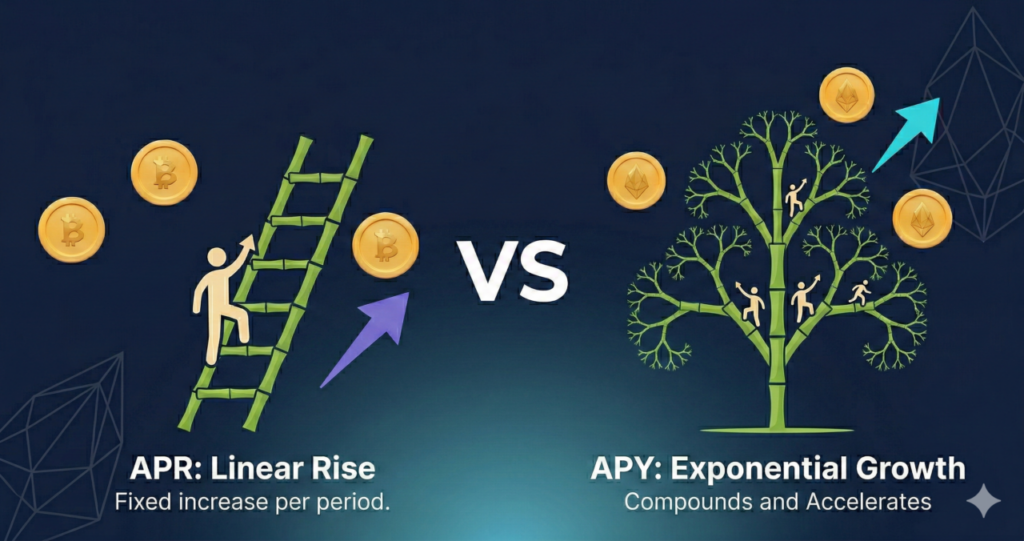
To choose between APR and APY opportunities, look at compounding first. APR is simple interest: what you earn without reinvesting. APY includes compounding, so your staking rewards earn rewards too. For crypto staking, APY almost always beats APR because compounding in crypto staking happens automatically on many platforms. This guide breaks down both so you never confuse them again.
Why the Confusion Costs You Money
Crypto staking has exploded as a way to earn passive income. Lock your coins, support the network, get paid. Simple, right?
Except when you see 8% APR here and 10% APY there. Which is better? The difference isn’t just 2%. It’s the difference between simple math and compounding magic.
This article covers:
- What APR actually means for your wallet
- What APY does with compounding
- How to compare them side by side
- Why some platforms show one and not the other
- How to pick the right opportunity
What Is Crypto Staking?
Crypto staking means locking your tokens to help secure a Proof-of-Stake blockchain. You become part of the network’s security system. In return, you earn rewards. Usually more of the same token .
Where do APR and APY show up? Everywhere in crypto:
- Staking platforms show your expected returns
- Lending protocols use them for interest rates
- Yield farming APYs can look crazy high (but carry crazy risk)
What Is APR (Annual Percentage Rate)?
APR is simple interest. No compounding. No magic. Just straight math.
How it works:
You stake $1,000 at 10% APR. After one year, you have $1,100. Done. Simple.
Example: Stake 100 SOL at 7% APR = 7 SOL earned after one year. No reinvestment assumed.
Why it matters:
- Easy to compare base rates
- Good for short-term holds
- Shows you the raw reward rate before compounding
What Is APY (Annual Percentage Yield)?
APY includes compounding. Your rewards earn rewards. Over time, this snowballs.
How it works:
You stake $1,000 at 10% APY with monthly compounding. After one year, you have about $1,104.70. That extra $4.70 is compounding at work .
The formula: APY = (1 + r/n)^n – 1
r = interest rate
n = compounding periods per year
Real example: 12% APR with daily compounding becomes roughly 12.75% APY . That’s a real difference.
Compounding frequency matters:
- Daily compounding = highest returns
- Monthly compounding = good
- Yearly compounding = basically APR
APY vs APR: Key Differences
| Factor | APR | APY |
|---|---|---|
| Compounding | None | Yes. Rewards earn rewards |
| Return Type | Simple interest | Compound interest |
| Accuracy | Shows base rate | Shows true earning potential |
| When to Use | Short-term, no reinvestment | Long-term staking, auto-compound |
| Typical in Crypto | Lending, some staking | Staking with auto-reinvest, DeFi |
When Platforms Show APR vs APY
Centralized exchanges (CeFi) often show APR . Why? It looks simpler. But you need to check if they compound automatically behind the scenes.
DeFi protocols and staking platforms love APY. It looks bigger. 12.75% APY sounds better than 12% APR, even though they’re the same thing with daily compounding .
Marketing bias is real. Higher numbers attract users. Always check what you’re actually getting.
Examples from real platforms in 2026:
- Ethereum staking: ~3-4% APR
- Solana: ~5-7% APY with compounding
- Polkadot: ~7-12% depending on validator and compounding
Risks & Misconceptions About APY
Variable APY in DeFi: That 20% APY today might be 5% next month. Rates change with demand, protocol usage, and market conditions .
Token inflation can eat returns: Some protocols pay high APY by minting new tokens. If they mint 30% more tokens and you earn 20% APY, you’re actually losing value .
High APY ≠ low risk: 20% APY on a sketchy protocol means you might lose principal. Always check:
- Smart contract audits
- Team reputation
- Total value locked (TVL)
- Community trust
Lock-up periods matter: Fixed staking offers higher rates but locks your funds. Can’t sell during a crash. Flexible staking pays less but you can exit anytime .
How to Choose Between APR and APY Opportunities
1. Compare compounding frequency first: Two platforms with 10% APY aren’t equal if one compounds daily and one compounds monthly. Daily wins .
2. Check reward token volatility: Getting paid in a coin that drops 30% wipes out your yield. Look at the token’s price history .
3. Evaluate lock-up duration: Longer locks should pay more. If they don’t, something’s wrong.
4. Understand auto vs manual reinvestment: Some platforms auto-compound (true APY). Others make you manually claim and restake. Manual means you might not get full APY unless you’re diligent .
5. Calculate effective yield: Use the APY formula to compare apples to apples:
- Platform A: 10% APR, daily compound
- Platform B: 10.5% APR, monthly compound
- Run the numbers. Daily likely wins.
Final Words
APR is your baseline. It tells you the raw reward rate before compounding.
APY is your real earning potential. It includes the snowball effect of rewards earning rewards.
Smart staking decisions require understanding both. When you see a rate, ask:
- Is this APR or APY?
- How often does it compound?
- Is the rate fixed or variable?
- What are the lock-up terms?
- How risky is the platform and token?
Ready to put your crypto to work with clear, competitive rates? Check out BTZO Staking options now and start earning passive income you can actually calculate.